

Freeze-Dried Food…Dogs Eat It Up
- By : PureAire Monitoring Systems
- Posted on : June 25, 2019
- News Room
Overview
As dog owners, we treat our pets as we do our children, taking care that the food we give them is not only filling and nutritious but contains only high-quality ingredients sourced and processed in ways that meet our exacting standards.
For many owners, far in the past are the days of grabbing any old bag of kibble off the shelf and feeding it to Fido or Ginger. Dog owners today are making informed choices in their purchases of pet food, such as whether the ingredients are all-natural or organic, whether they contain allergens to be avoided, which proteins predominate in the mix, etc. Not only are owners increasingly educated about what goes into their dogs’ food, they are faced with many choices when it comes to exactly what form the food will take.
Types of Dog Food
Major pet food types available to contemporary dog owners, from a wide array of manufacturers, include dry food, semi-moist, canned, raw, and freeze-dried food.
Dry food, commonly known as kibble, is the most prevalent type of dog food on the market. Semi-moist food is served either on its own or added to kibble for a variety of tastes and textures. Canned food is a moist product with a long shelf life. Raw food appeals to owners who believe that an uncooked all-meat diet is closer to what dogs would have eaten in the wild, before they became domesticated. Raw foods may be produced and sold as either fresh, fresh frozen, or freeze-dried.
Freeze-Dried Dog Food
The freeze-dried dog food segment–including 100% freeze-dried meals, so-called “kibble+” (dry kibble mixed with freeze-dried components), and freeze-dried treats, such as beef liver and other types of training tidbits–currently commands only a niche share of the ~$30 Billion U.S. dog food industry, but it is rapidly growing in popularity among owners seeking, as in their own diets, to avoid highly processed foods.
Purchasing freeze-dried proteins, whether cooked or raw, as well as fruits and vegetables (which are typically freeze-dried in a raw state), allows owners to provide their pets with minimally processed, nutrient-rich, natural foods. Freeze-drying quality ingredients makes for an easily transportable, shelf-stable tasty food that does not require refrigeration.
Gas Usage in Freeze-Dried Food Processing and Packaging
Food safety is as important in the pet food industry as it is in the manufacturing and distribution of human-grade foodstuffs. Proper temperatures must be maintained in order to prevent mold and bacteria growth resulting from, among other things, improper cooking and cooling temperatures, as well as insufficient or excessive moisture.
Quality control and safety concerns dictate that, because of their rapid cooling and freezing properties, liquid nitrogen (LN2) and liquid carbon dioxide (liquid CO2) be used in pet food production to uniformly cool proteins after cooking, and to freeze them as part of the freeze-drying process. Once properly chilled, the proteins and other ingredients that go into a freeze-dried dog food product are quickly frozen in blast freezers using LN2 or liquid CO2. After freezing, they are placed into vacuum drying chambers for some 12 hours, until the drying process is complete (i.e., essentially all moisture has been removed), following which the food is ready for packaging.
To prolong dog food shelf life (by inhibiting the growth of mold and bacteria which thrive in oxygenated environments), nitrogen is injected to displace oxygen from the product packaging. The addition of nitrogen during the packaging phase also provides a cushion to protect the contents from settling and breakage that can occur during shipping and handling.
Oxygen Monitors Can Improve Safety in Pet Food Manufacturing and Packaging
While their use is essential in the production of freeze-dried dog food, nitrogen and carbon dioxide can pose health risks (including death by asphyxiation) to employees working in the industry. Nitrogen and carbon dioxide are both odorless and colorless, and they displace oxygen. Absent appropriate monitoring, workers would be unable to detect a leak if one were to occur in a gas cylinder or line. Conversely, by utilizing a top-quality oxygen monitor, safety and production personnel can track oxygen levels and detect leaks before workers’ health is jeopardized.
PureAire Monitors
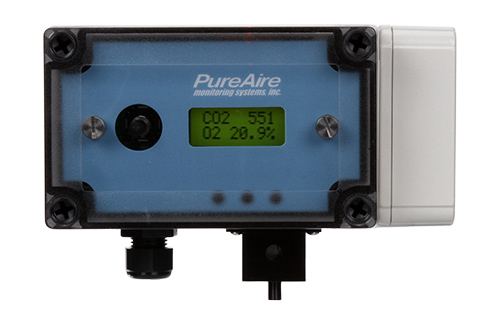
With PureAire Monitoring Systems’ dual oxygen/carbon dioxide monitor, pet food producers can track levels of oxygen and detect nitrogen or carbon dioxide leaks before workers’ health is at risk. PureAire’s O2/CO2 monitor measures oxygen and carbon dioxide 24/7, with no time-consuming maintenance or calibration required. PureAire’s monitors can handle temperatures as low as -40C, making them ideally suited for environments, such as pet food processing plants, that use liquid nitrogen and carbon dioxide.
Built with zirconium oxide sensor cells and non-dispersive infrared sensor (NDIR) cells, to ensure longevity, PureAire’s O2/CO2 monitors can last, trouble-free, for over 10 years under normal operation conditions.