

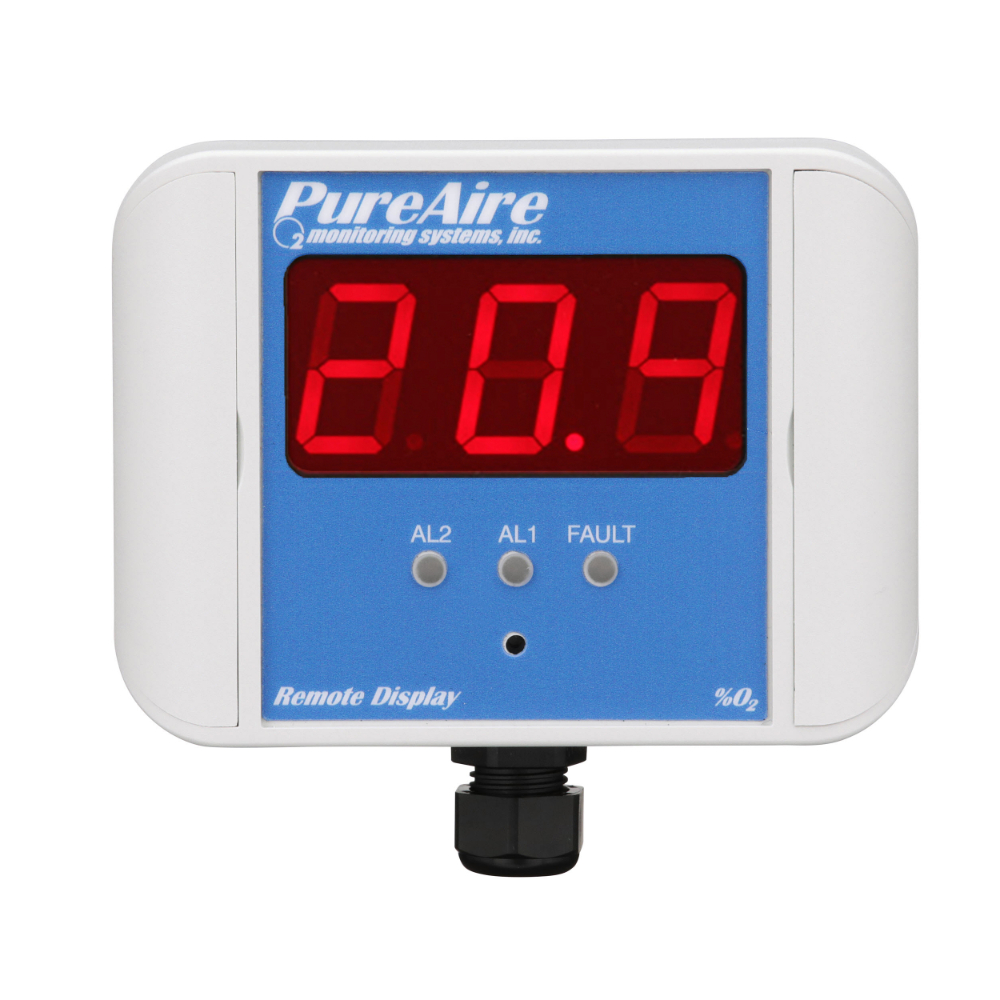
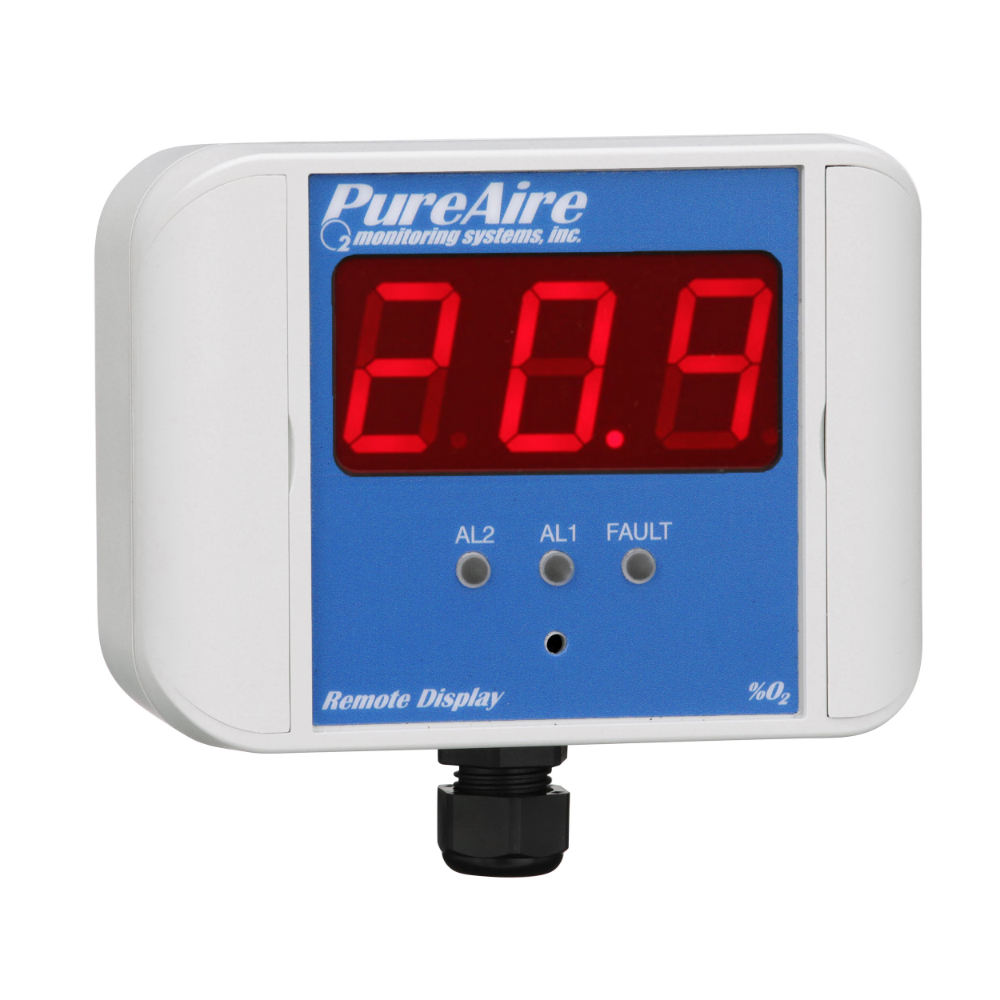
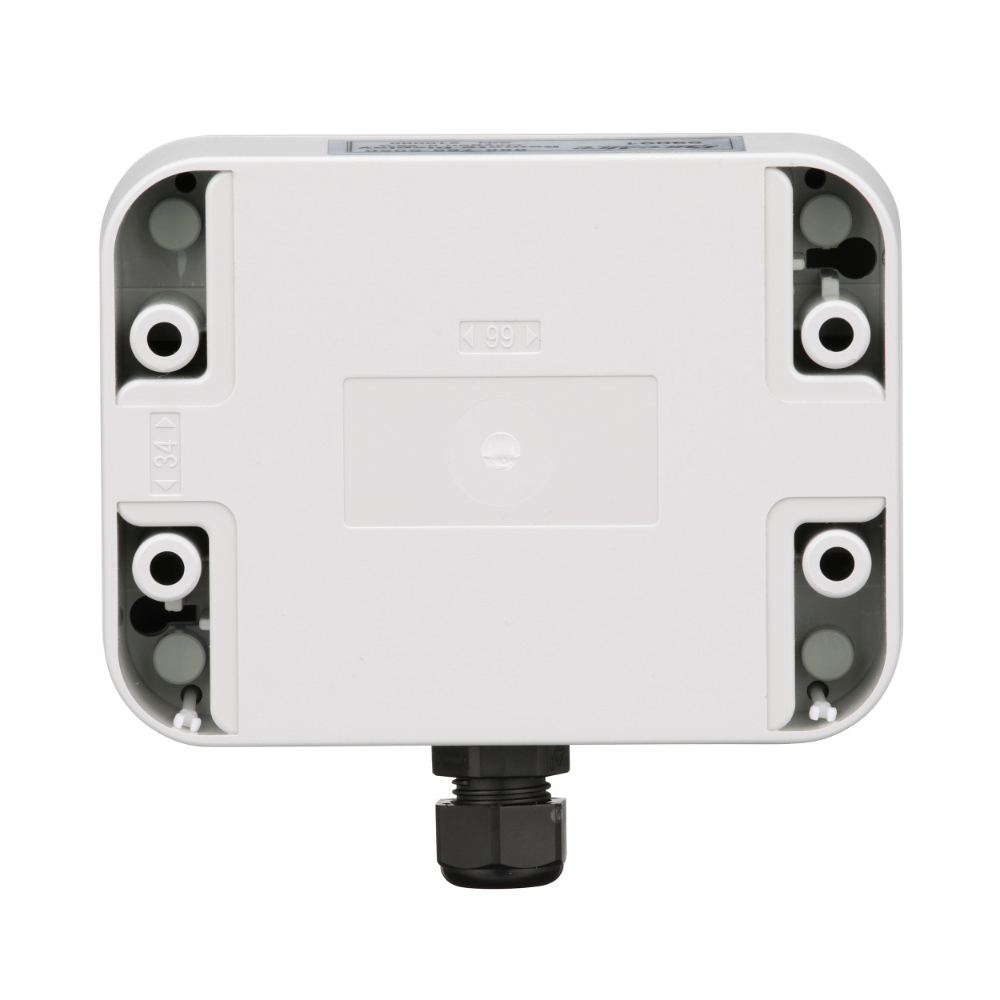
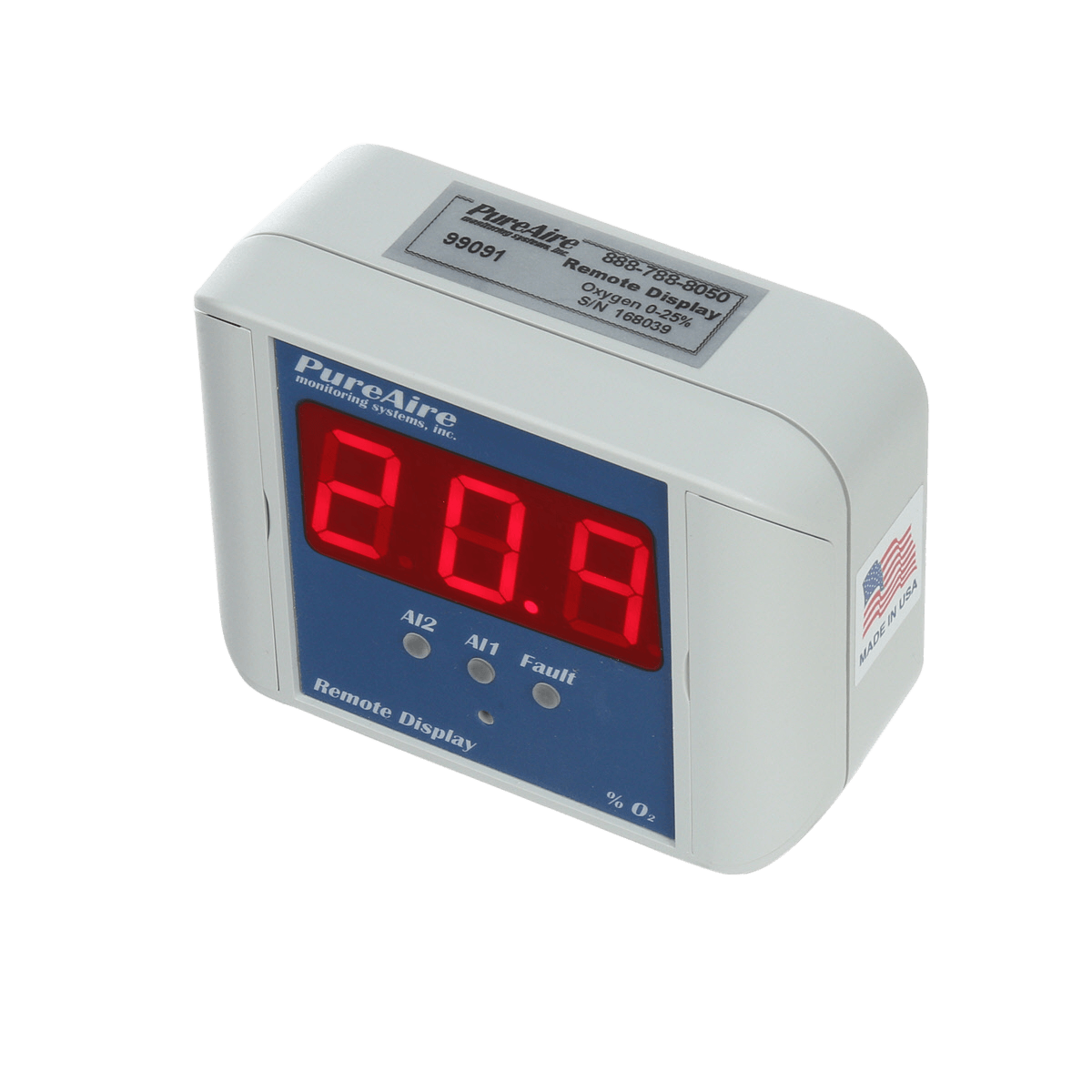
Remote Digital Display

Available Product Options. Please choose from the menu below | In stock

$480.00

Product Summary
  • Bright 1” Red LED digital concentration display
  • Built-in Alarm and Fault status LED’s
  • User-selectable dual-level alarm set points
  • Built-in Audio horn alerts personnel to low or
    high oxygen conditions
  • Two-tone horn distinguishes between alarm 1
    and alarm 2
  • Displays Oxygen monitor overall status
We can ship next day with orders placed by Noon CST
Quantities less than 10 pieces ship next day. Estimated lead times do not include weekends or holidays. Transit time is determined by shipping method and destination. Orders requiring credit information might take additional time.

The Remote Digital Display provides continuous information on the status of the PureAire oxygen deficiency monitors, O2 analyzers, or gas detectors by remotely mirroring the monitor’s display. A large, bright red LED display continuously illuminates the O2 reading from the oxygen monitor up to 250 feet away.

You can select two individual alarm set points to activate the visual alarm LEDs and audible horn. High-intensity LEDs illuminate whenever preset alarm levels are exceeded. An additional fault LED indicator for system errors is also included. The remote digital alarm indicator has a 90dB built-in horn to alert personnel when an unsafe condition exists.

PureAire’s Remote Digital Display connects to an oxygen monitor using a 3-wire, 18-gauge shielded cable.
The Remote Digital Display can also be connected to a programmable logic controller (PLC), providing simultaneous alarm and status indications in multiple locations throughout the facility.

Specifications

Part Number: 99091
Operating Temperature:  -40 to +122F (-40 to +50C)
Display: 1” bright red digital
Horn: User selectable on/off
Audible: Horn Sound Output 80 – 85 dB
Enclosure: ASA+PC plastic
LED Lights: (2) relay lights, (1) fault light
Alarms: 2 User-adjustable alarm above or below the setpoint
Power Requirements: 24VDC supply connected from O2 monitors
60 mA
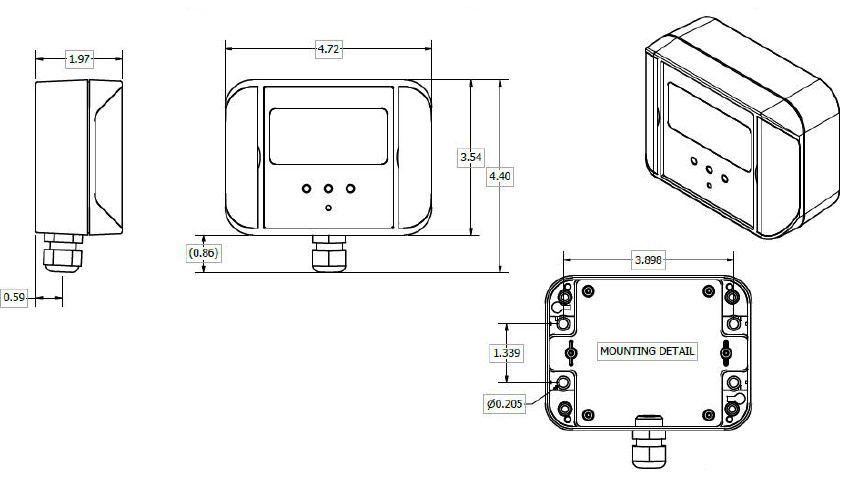
Dimensions:  4.6”(W) x 3.5”(H) x 2″(D) inches (116.8mm x 88.9mm x 50.8mm)
Weight: .5 pounds (1.1 kg)
Enclosure:  Polycarbonate wall mount general-purpose; not intended for explosive atmospheres.
Country of Origin USA
Harmonized Tariff Code 9030.32.0000


Remote Display Literature

Remote LED Display Installation Manual  –Oxygen Monitors

Remote LED Display Installation Manual – EPU/MPS LEL Monitors

Remote LED Display Installation ManualUniversal Gas Monitor

Remote LED Display Installation ManualST-48 Model LEL Monitors

High-Visibility Readings

Clear concentration display supports quick checks at a distance.

Clear Status Indication

Alarm and fault indicators show monitor status at a glance.

Better Situational Awareness

Useful at entrances, corridors, or control rooms.

Faster Decision-Making

Makes it easier to confirm safe conditions before entry.

Oxygen deprivation is a silent killer. Oxygen-depleting gases, such as nitrogen, argon, and helium, are odorless and colorless, making leaks impossible to detect, unless appropriate monitoring is in place.

PureAire oxygen deficiency monitors can be used to monitor nitrogen, argon, and helium. Carbon dioxide can also be monitored with PureAire’s dual oxygen/carbon dioxide monitor.

PureAire uses a proprietary, non-depleting, zirconium oxide sensor that will last up to 10 years in a normal environment without needing to be replaced.

PureAire’s sensors do not operate under partial pressure, meaning that a PureAire sensor will not need to be adjusted to account for different elevations. Additionally, the sensors will not drift due to changes in barometric pressure.

In contrast, other gas detection companies use depleting, electrochemical sensors. These sensors, because they are depleting, operate for 1-2 years before needing to be replaced. Electrochemical sensors do not offer long-term solutions to companies committed to safety.

PureAire sensors are built to last 10 years. Often, the sensors work much longer. In fact, some of our first customers who started using PureAire products in 1997 report that the sensors are still in operation today.

On the other hand, an oxygen monitor that uses a depleting, electrochemical sensor is like a battery in that, as the sensor depletes, it begins to lose its power and responsiveness. In order to operate accurately, electrochemical sensors must be calibrated frequently.

PureAire sensors are made of non-depleting zirconium oxide, and calibration is typically not required.

However, a visual check of the monitor should be done once a year to verify that the sensor is functioning properly, and span adjustments should be done, as necessary. The sensor requires periodic testing with nitrogen to verify the sensor’s response to low oxygen levels.

In contrast, electrochemical sensors, because they deplete over time, will need to be calibrated every 2-3 months and totally replaced every 1-2 years.

Switching to a PureAire non-depleting, zirconium oxide sensor will save you time and money, while ensuring the safety of your workers and facility.

Electrochemical sensors offered by other gas detection companies lose accuracy over time and must be calibrated. Calibration recharges and resets the monitor to get an accurate reading. It is important to note that an electrochemical sensor can only be calibrated a finite number of times before it must be discarded.

PureAire’s non-depleting zirconium oxide sensor will not experience drift. Oxygen sensors from PureAire will provide long-lasting, reliable, and accurate monitoring for an average of10+ years.

The oxygen monitor covers an area of approximately 692 square feet when mounted on a wall and should be placed no more than 21 feet from potential leak sources such as gas lines, gas cylinders, or any areas where a gas leak might be expected to occur.

To ensure safety, the maximum distance between two monitors mounted to the same wall, should not exceed 30 feet. However, since cryogenic gases, such as argon, helium, and nitrogen, are unpredictable, we encourage you to contact PureAire for additional guidance specific to your needs.

In most circumstances, PureAire recommends that oxygen monitors be installed 3-5 feet away from gas cylinders or cryogenic gas lines. To enable employees to see the monitor display and verify its performance, PureAire recommends mounting an oxygen monitor 3-5 feet off the ground.

There are other options for mounting an oxygen monitor. For instance, PureAire sensors can sample the air from up to 100 feet away, or be installed within a glovebox, freezer, sealed chamber, or even underground. PureAire monitors can also work in environments that require KF-25 flanges, as well as in nitrogen/argon enriched environments.

PureAire’s Sample Draw Monitors pull a sample flow at a rate of 250 ccs per minute. We recommend using 1/4” OD x 3/16” ID polypropylene sample tubing. Using this internal tubing dimension, to calculate transport (response) time, add 2 seconds per foot of sample tubing. For example, if the sample tube is 10 feet long, the initial response time would be 20 seconds (10ft x 2seconds=20seconds) at 15 feet the response time would be 30 seconds (15ft x 2seconds=30seconds), etc.

The response time when using the entire 100 feet of sample tube will take 3.5 minutes (100ft x 2seconds=200seconds or 3.5minutes) for the sample to reach the monitor.