

PureAire Makes Oxygen Monitor for Nitrogen Generators
- By : PureAire Monitoring Systems
- Posted on : July 14, 2012
- News Room
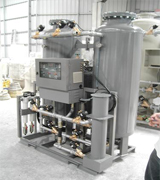
Nitrogen generators are most commonly used in areas where on-demand nitrogen is preferred rather than, storing liquid nitrogen (LN2) in cylinders. Nitrogen generators have a lower cost of operation, and can be used where smaller amounts of nitrogen are needed. Nitrogen generators are used in the pharmaceutical industry, testing laboratories, cryogenic facilities, welding manufactures, and petrochemical environments.
The question often comes up from a safety standpoint, is nitrogen a safe? The answer is usually no. An Oxygen Monitor is needed where LN2 or nitrogen generators are stored. Nitrogen makes up roughly 70% of the air we breathe, though oxygen is only 20.9%. Oxygen is a precious gas that we take for granted. Ultra pure 99.9% nitrogen is unsafe in confined spaces, and nitrogen generators are usually stored in these types of areas. PureAire has developed an Oxygen Monitor with a 10+ year sensor made specifically for nitrogen storage areas, and nitrogen generators.
PureAire’s O2 Monitor uses a called Zirconium Oxide sensor. Most Oxygen Monitors use a disposable electrochemical sensor that typically only has a life expectancy of 12-18 months along with other complications. Some examples of problems with the electrochemical sensors are: drifts to thunderstorms, or barometric pressure changes, humidity changes, and temperature fluctuations.
PureAire has pioneered the way using a zirconium oxide oxygen sensor. The technology used is far more advanced than the “Old style,” electrochemical sensors. The sensor used is based on ions being passed through the sensor, and at 20.9% oxygen a certain quantity of ions cross the sensor. Thus, giving a current to the monitor giving an accurate reading between 0-25%. If the oxygen concentration has been lowered, fewer ions cross the sensor hence, lowering the reading on their display. Intuitively, if there is higher known concentration of oxygen, so will the sensors readings on the PureAire Oxygen monitor.
The crucial understanding of the sensor is what gives PureAire’s clients the 10+ life expectancy and accuracy. Another great property of the ZrO2 sensor is NO CALIBRATION is required. The sensors ion technology limits the need to calibrate. PureAire’s Oxygen monitor does not have problems with barometric pressure, temperature, or humidity changes. PureAire’s O2 Monitors are completely stable (-40c to 50c) in all environments.
Nitrogen generators create high pressure in the cylinder after the gas has been created. This can be dangerous especially, overnight while employees are not in the proximity. PureAire also has a feature called latching. If there is a leak overnight, the alarm can stay alerted until the client turns off the switch in the morning.
PureAire is also looking for distributors to help distribute their oxygen monitors. In the past year PureAire has grown 50% and is continuing to gain more recognition. The demand for the O2 monitors has been more abundant exponentially. The PureAire ion based technology O2 monitor should be the only monitors being sold for 0-25% due to the lack of maintenance and calibration.
If you have anymore questions, please contact PureAire sales at www.PureAireMonitoring.com, or www.MonitorOxygen.com. The toll free number is 1-888-788-8050, or call 1-847-726-6000. Local fax number is 1-847-726-6051.